
How Much Paint Do I Need? A Room-by-Room Guide (2026)
A clear, practical guide to estimating interior paint: the coverage rule that matters, a formula you can do in your head, and worked examples for every room.
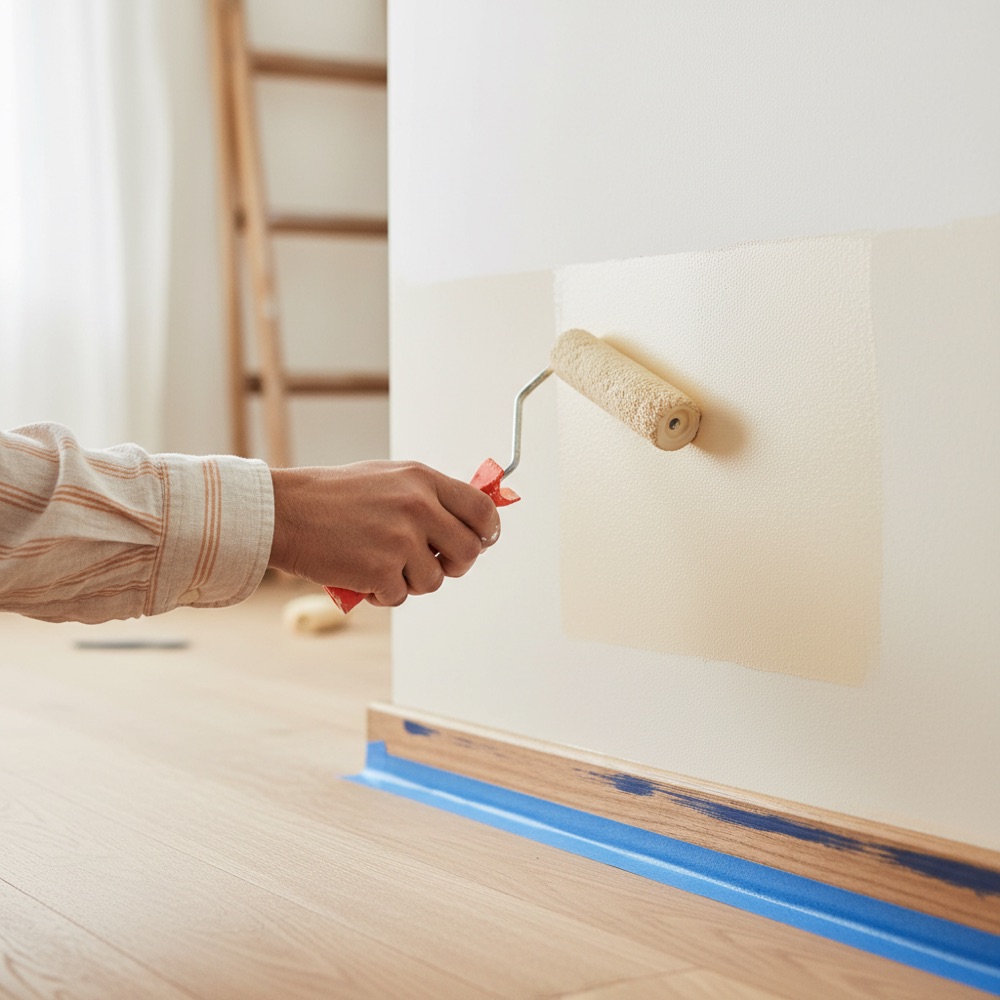
"How much paint do I need?" is the first question of every painting project — and getting it wrong costs you either a second trip to the store mid-job or a shelf of half-used cans. This guide gives you a simple, reliable way to estimate interior paint, room by room, in plain U.S. units. When you are ready for an exact number, run your room through the paint calculator.
The one rule that matters: coverage
Everything starts with coverage — how much wall a gallon will paint. The industry rule of thumb is that one gallon covers about 350 to 400 square feet in a single coat on a smooth, primed, previously painted surface. At CalcReno we plan with 350 sq ft per gallon, the conservative end, so you are less likely to run short.
Two things eat into that number:
- Porous or rough surfaces. New drywall, bare wood, and heavily textured walls soak up paint. Real-world coverage can fall to 250–300 sq ft per gallon. Priming first restores most of your coverage and saves paint overall.
- Color and number of coats. Going from a dark wall to a light one, or covering patches and repairs, almost always needs two coats. Plan for two unless you are refreshing the exact same color on a clean wall.
The formula you can do in your head
Here is the whole calculation in four steps. We will use a standard 12 × 12 ft bedroom with 8 ft ceilings as the example.
- Wall area = 2 × (length + width) × height.
2 × (12 + 12) × 8 = 2 × 24 × 8 = 384 sq ft. - Subtract openings. One door at 21 sq ft and two windows at 15 sq ft each = 51 sq ft. That leaves 333 sq ft of actual wall.
- Multiply by coats. Two coats × 333 = 666 sq ft of coverage needed.
- Divide by 350 and round up. 666 ÷ 350 = 1.9, so buy 2 gallons.
That is it. The same four steps work for any rectangular room. For odd shapes, break the room into rectangles, calculate each, and add them up.
Room-by-room cheat sheet
These are quick planning estimates for walls only, two coats, 8 ft ceilings, at 350 sq ft per gallon. Always confirm with a measurement and the calculator.
| Room | Typical size | Wall area (approx.) | Paint for 2 coats |
|---|---|---|---|
| Powder room / half bath | 5 × 5 ft | ~150 sq ft | 1 gallon |
| Small bedroom | 10 × 10 ft | ~270 sq ft | 2 gallons |
| Standard bedroom | 12 × 12 ft | ~333 sq ft | 2 gallons |
| Living room | 16 × 20 ft | ~520 sq ft | 3 gallons |
| Open-plan great room | 20 × 30 ft | ~750 sq ft | 4–5 gallons |
Don't forget ceilings and trim
Walls are only part of the job. Two separate products usually come into play:
- Ceiling paint is a flat, spatter-resistant formula. Calculate it on the floor area (length × width). A 12 × 12 ceiling is 144 sq ft — well under a gallon for one coat, but buy a full gallon for two.
- Trim, doors, and baseboards use a durable semi-gloss or satin. A quart goes a long way on trim; a gallon covers the trim in several rooms. Measure linear feet of trim rather than wall area.
How much paint for a whole house?
To estimate an entire interior, add up the wall area of every room and divide by your coverage. As a loose benchmark, a 2,000 sq ft single-family home often needs in the neighborhood of 15–20 gallons of wall paint for two coats, plus separate ceiling and trim paint. The only way to get an accurate total is room by room — so walk the house, measure, and total it up.
Five ways to avoid over- or under-buying
- Prime new and patched surfaces so your coverage estimate holds.
- Buy a single extra quart for touch-ups rather than a whole extra gallon you will not use.
- Keep the can and lot number. If you need more, the same batch guarantees a perfect match.
- Stir, don't shake, leftover paint and store it sealed and cool — it can last for years for touch-ups.
- Round up, not down. Running out at 90% finished is the worst outcome; a little leftover is normal and useful.
Ready to nail down your exact number? Open the paint calculator, or make sure you have the right gear with our essential painting tools guide.